
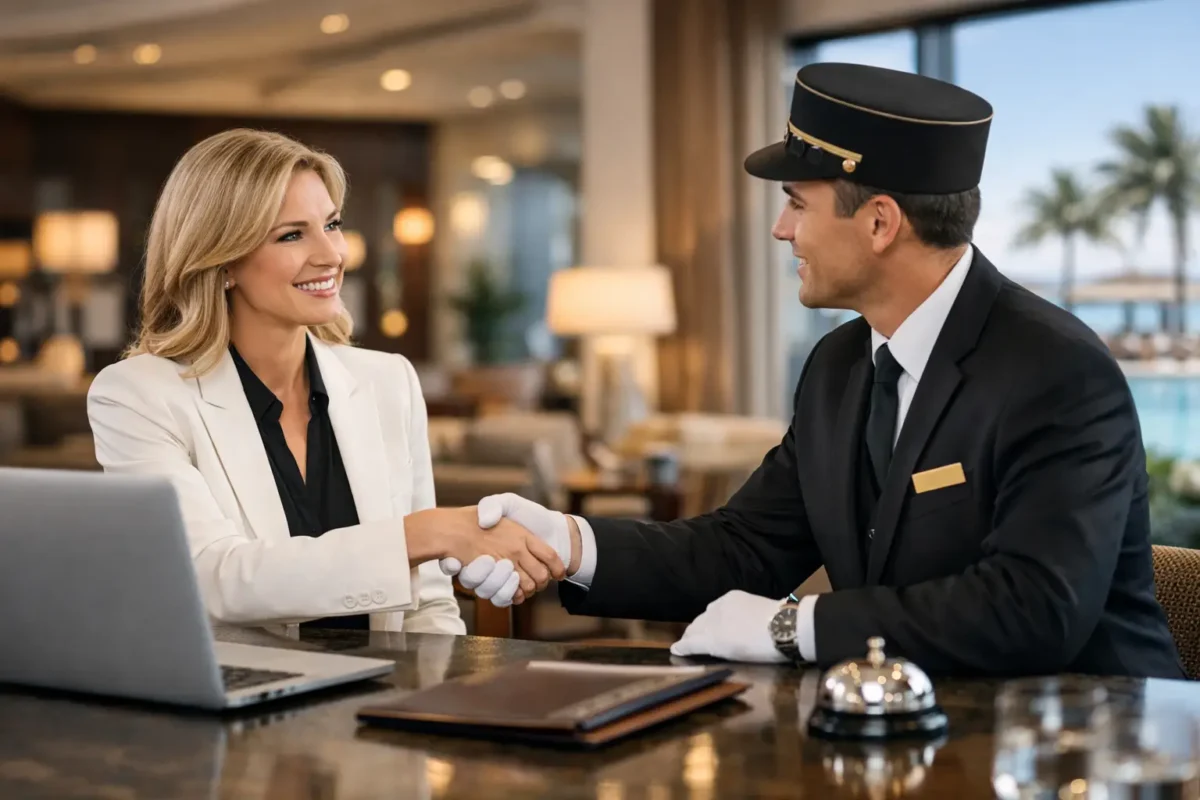
A senior guest should never have to ask where their car is, whether their dietary requirement has been noted, or who is meeting them at the hotel. Those small moments shape the perceived quality of an entire programme. Executive hospitality management services exist to make every interaction feel considered, while giving internal event owners confidence that the detail is under control.
For corporate events, hospitality is not simply a welcome desk or a reservation list. It is the disciplined coordination of people, places, information and timing around the attendees whose experience carries the greatest business weight. This may include C-suite leaders, board members, customers, partners, speakers, regional sales heads or overseas delegates. Their expectations differ, but the standard is the same: clear communication, sound judgement and discreet care.
Why executive hospitality carries business weight
At a customer dinner, leadership summit or regional conference, executives are often asked to make the most of limited time. They may be arriving from another market, moving between meetings, hosting important conversations and representing their organisation throughout. A poorly handled transfer or a last-minute room change does more than create inconvenience. It interrupts their ability to focus on the purpose of the event.
Hospitality therefore protects both relationships and reputation. When guests are welcomed by someone who knows their schedule, preferences and role in the programme, the event feels assured. When a change is communicated before it becomes a problem, the organisation appears prepared rather than reactive.
This is particularly relevant across Asia-Pacific, where multi-market programmes can involve different arrival patterns, languages, venue practices and cultural expectations. The right level of hospitality is rarely about making every element elaborate. It is about understanding what matters to each audience and delivering it consistently.
What executive hospitality management services involve
The work begins well before guests arrive. A capable hospitality team builds a precise picture of the attendee journey: who is travelling, when they need to be met, which sessions they are attending, where they are staying and any requirements that need careful handling. It connects this information with the wider event plan, rather than treating hospitality as a separate workstream.
For an executive group, that may mean coordinating airport transfers, hotel rooming, priority registration, secure itinerary distribution, hosted meals, meeting-room access and departures. For a larger conference, the focus may shift towards VIP hosting, speaker liaison, hosted buyer schedules, invitation management and an escalation process for exceptions.
The scope should reflect the programme, not a fixed package. A leadership offsite with 30 attendees needs a different approach from an international sales meeting for 500 people or an exhibition welcoming more than 1,000 delegates. In each case, the hospitality plan should be scaled to protect high-value interactions without creating unnecessary complexity.
Arrival is only the first impression
Travel and arrival coordination are often where good planning becomes visible. Guests need accurate joining instructions, practical contact details and a clear understanding of what happens next. For overseas delegates, this can include aligning flight information with transfer windows, hotel check-in arrangements and the timing of early programme commitments.
Contingencies matter just as much. Flights are delayed, luggage goes missing and traffic conditions change. The most useful response is not a lengthy explanation but an informed host who can make a decision, update the relevant people and offer an appropriate alternative. That requires live coordination between transport providers, hotels, venue teams and the client’s event leads.
Personalisation requires discipline
Executive hospitality can be personal without becoming intrusive. Dietary needs, accessibility arrangements, preferred forms of address and travel details should be managed with care, shared only with people who need to know, and reflected accurately in delivery.
The trade-off is clear: collecting too little information can lead to avoidable mistakes, while collecting too much can become burdensome and difficult to control. A well-managed process requests only what is relevant, confirms critical details at the right stage and keeps one current source of truth for the delivery team.
Hosting is an operational role, not a ceremonial one
A polished host does more than greet attendees. They anticipate movement, recognise when a guest needs privacy, identify the right person to solve an issue and maintain the pace of the programme. They must be warm and composed, but also fully briefed on schedules, seating plans, protocol, venue layouts and escalation contacts.
That is why on-site briefing matters. Every host should understand the event’s business purpose, the profiles of key guests and the boundaries of their authority. If a VIP arrives early, a speaker requests a private conversation, or a senior customer has a transport issue, the response should be timely and coordinated rather than improvised.
Designing hospitality around the event objective
The strongest hospitality plans start with the question: what must this audience be able to do? For a customer engagement programme, the answer may be to build rapport in an environment that feels attentive but unforced. For a leadership meeting, it may be to protect time for decisions and candid discussion. For an incentive trip, it may be to create a sense of recognition while keeping logistics dependable.
This perspective changes practical choices. A formal hosted dinner may suit a relationship-building evening, but a private pre-function reception could be more valuable when senior guests need time to meet one another before a keynote. Likewise, an executive transfer may be necessary for a tightly scheduled visit, whereas a shared arrangement can work well for a broader delegate group if timings are reliable and clearly communicated.
It also helps clients use budget with purpose. Visible hospitality touches should support the desired experience, but investment in behind-the-scenes planning often delivers the greatest protection. A carefully maintained run sheet, experienced on-site coordinator and responsive communications channel can prevent issues that no amount of decorative detail will solve.
The details that protect the guest experience
Executive hospitality succeeds when it is connected to the event’s operating rhythm. This requires close coordination with venue teams, registration, food and beverage, transport, accommodation, speakers and programme managers. A hotel may have the right rooms, for example, but the guest journey can still falter if check-in is not aligned with transfer arrivals or if a private meeting room is released too early.
A practical hospitality plan should establish ownership for every important handover. Who confirms a late arrival? Who meets a guest at the lobby? Who is authorised to change a table allocation? Who updates the host when the agenda runs over? These questions are straightforward, yet they are frequently where service standards are won or lost.
Communication should be concise and appropriate to the audience. Senior attendees generally do not need operational detail, but they do need accurate information at useful moments. Internal stakeholders, meanwhile, need enough visibility to make informed decisions without being drawn into every live adjustment. The hospitality team acts as the calm link between those needs.
Choosing a partner for executive hospitality management services
For many organisations, executive hospitality involves several internal teams: marketing, sales, communications, procurement, leadership offices and regional colleagues. A partner should be able to listen to each perspective, turn decisions into a workable plan and provide clear accountability throughout delivery.
Look for experience across the formats and markets relevant to your programme. Cross-border execution is not merely a question of booking suppliers in another destination. It calls for local knowledge, realistic timing, dependable venue and transport coordination, and sensitivity to how guest expectations may vary across Singapore, Malaysia, Thailand, Indonesia, Vietnam, Hong Kong, Macau, Korea, Japan and the Philippines.
It is also worth asking how the team handles change. The quality of a supplier is often most evident when a flight is delayed, an executive’s schedule shifts or a venue constraint emerges close to the event. A useful partner brings options, explains the implications and acts quickly within agreed parameters.
At iCube Events, this kind of work is approached as a close partnership rather than an isolated hospitality task. The aim is to match the right people and resources to the programme, so that clients retain confidence in the decisions being made and guests receive the attention their role warrants.
When executive hospitality is planned with care, it gives senior guests something increasingly rare at busy corporate events: the freedom to be fully present. That is the standard worth designing for.