
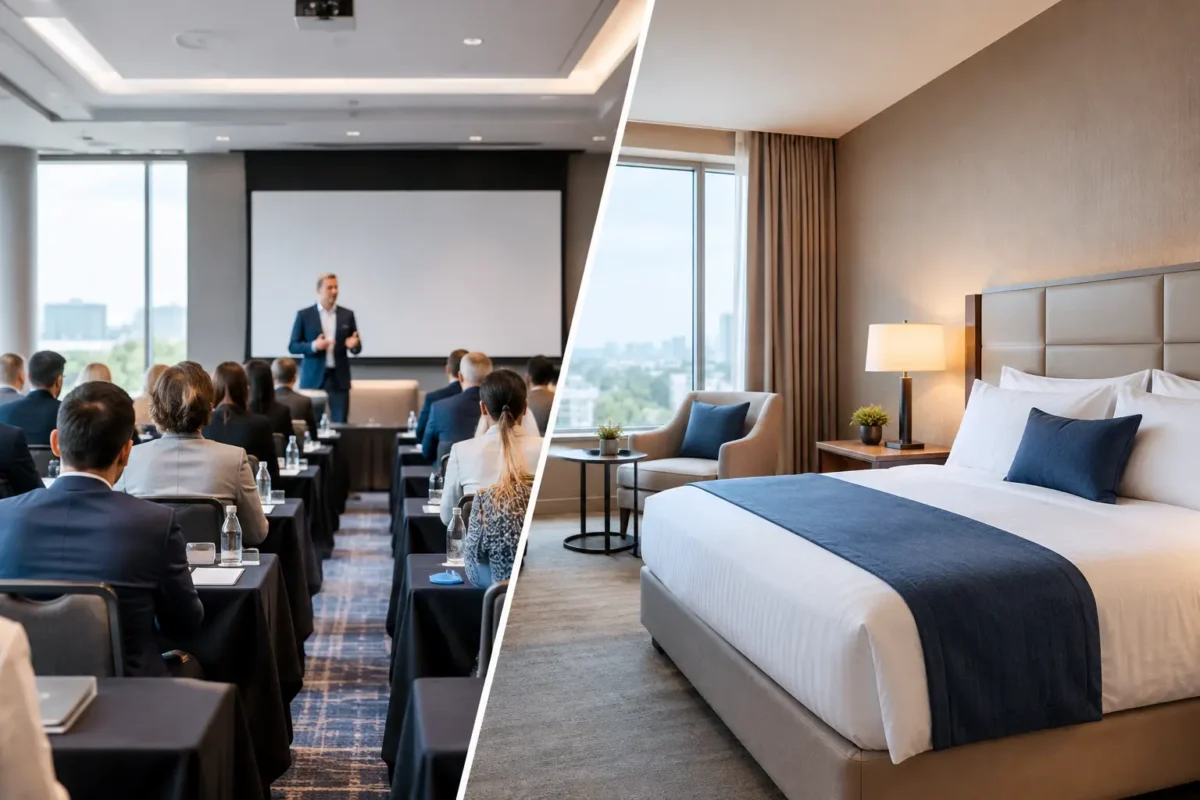
A venue short-list can look deceptively simple until the event brief becomes real. Delegates need to arrive easily, speakers need a calm holding area, exhibitors need reliable loading access, and senior stakeholders expect an environment that reflects the occasion. The conference venue versus hotel decision is therefore not simply about room hire. It shapes how people move, meet, rest and remember the programme.
For corporate events in Singapore and across Asia-Pacific, neither option is automatically better. A dedicated conference venue can give a major launch, forum or exhibition the space and presence it needs. A hotel can bring accommodation, hospitality and meeting facilities into one carefully managed experience. The right choice begins with the business objective, then considers the practical detail that protects it.
Conference venue versus hotel: start with the event purpose
The most useful question is not, “Which venue has the largest ballroom?” It is, “What must this event achieve?” A regional sales meeting may need concentrated working sessions, private leadership discussions and an evening recognition dinner. A customer conference may need a strong arrival experience, theatre-style content, sponsor visibility and space for meaningful conversations between sessions. An incentive programme may prioritise hospitality, guest comfort and a sense of destination.
Dedicated conference venues are often well suited to content-led programmes where production, scale and flexible use of space are central. They may offer purpose-built auditoria, large exhibition halls, generous foyer areas and practical access for staging, registration infrastructure and display builds. This can make them a strong choice for product showcases, industry conferences and events with hundreds or more than 1,000 attendees.
Hotels tend to work particularly well when the programme depends on convenience and hosted care. Delegates can sleep, meet, dine and attend evening functions in one location. For international teams arriving at different times, or for a multi-day leadership meeting with a full agenda, reducing transfers can improve attendance, punctuality and delegate comfort.
There are exceptions. A hotel may have excellent function space for a sizeable conference, while a conference venue near several accommodation options may be entirely practical. The brief, not the venue category, should lead the decision.
Consider the delegate journey, not just the main room
The meeting room is only one part of the attendee experience. Map the journey from invitation through to departure: transport, arrival, registration, wayfinding, breaks, networking, meals and onward travel. This exercise often reveals the real strengths and limitations of each setting.
When a hotel simplifies the experience
For delegates travelling from overseas or other Asian markets, a hotel can remove several points of friction. Accommodation and programme logistics sit under one roof, which is valuable when schedules begin early, end late or include hosted dinners. It also gives organisers greater visibility over guest arrivals and individual requirements, particularly for executive groups, speakers and VIPs.
Hotels can create a contained atmosphere for meetings that require discretion or focused participation. Delegates are less likely to leave between sessions, and informal conversations can continue in lounges, restaurants and shared spaces. For a strategy off-site or internal conference, this continuity can be more valuable than a larger event footprint.
However, hotel venues may have competing functions taking place at the same time. Arrival areas, lifts, restaurants and public spaces are shared with other guests. It is essential to understand how your group will be separated, welcomed and directed, rather than assuming the function room floor alone will deliver a dedicated event environment.
When a conference venue creates greater impact
A purpose-built venue can give an event clearer ownership of its surroundings. Branded registration zones, sponsor activations, exhibition stands and networking areas can be designed as a connected experience rather than fitted around a hotel’s existing layout. This is especially helpful when the event needs to feel distinct from a conventional meeting.
The operational advantages can be equally significant. Larger loading bays, more direct access to halls, higher rigging capacity and adaptable room configurations may make production planning more efficient. For a conference involving live demonstrations, substantial audiovisual requirements or a complex exhibition floor, these details affect the build schedule, safety planning and final presentation.
The trade-off is that delegates may need to travel between their hotel and the event site. In Singapore, public transport and short transfer times can make this straightforward, but timing still needs careful management. In regional destinations, traffic patterns, weather, local transport capacity and the location of suitable hotels should be assessed early.
Match the space to the programme flow
A venue should support how the day actually works, including the moments between formal sessions. Ask how many people must move at once, where they will gather, and whether the programme allows sufficient time for that movement.
A hotel ballroom can be effective for a plenary, lunch and gala dinner, particularly when the guest count is stable and the agenda is relatively contained. Yet a room that accommodates theatre seating may feel crowded once a stage, cameras, interpretation booths, backstage storage and technical control are included. The adjacent pre-function area also needs enough capacity for registration, refreshments and networking without creating queues.
Conference venues generally provide more scope to separate functions. Delegates can move from a plenary hall to breakouts, an exhibition zone and a dining area without requiring the same room to be reset repeatedly. This is useful for content-rich conferences, regional kick-offs and trade events where programme flow needs to remain smooth even as attendance moves between different spaces.
For either setting, review floor plans against the operational brief rather than relying on capacity charts. Consider sightlines, ceiling heights, pillar positions, door widths, accessible routes, green rooms, organiser offices, storage and the distance between rooms. A good layout does more than fit the guest list. It keeps the programme composed when timings are tight.
Look beyond venue hire to operational readiness
Venue decisions should be tested against the full delivery requirement. This includes technical infrastructure, internet capacity, catering logistics, security arrangements, registration equipment, branding permissions, exhibitor access and contingency plans. A favourable initial proposal can become less suitable if it cannot accommodate the programme as designed.
Hotels may offer established banquet teams and well-practised event operations, which can be reassuring for formal meetings and hospitality-led programmes. Their food and beverage service is often integrated with the venue schedule, and accommodation coordination can be handled closely with the event team. Confirm, however, the flexibility around meal timings, dietary needs, external production partners and branding elements.
Conference venues may offer stronger infrastructure for exhibitions and high-specification production, but some operational components may require more coordination between venue teams and specialist suppliers. That is not necessarily a disadvantage. It can allow a more tailored event design, provided responsibilities are clear and the schedule allows for proper technical planning.
Across both options, service culture matters. The best venue partner responds constructively when flight schedules change, a keynote session overruns or a last-minute attendee requirement emerges. Site inspections and detailed planning conversations are often the clearest way to assess this. Look for teams that understand the programme objectives, raise practical questions early and follow through on agreed actions.
Account for destination and accommodation strategy
For Asia-Pacific events, the venue choice is closely linked to the destination experience. A central Singapore hotel may be ideal for an executive meeting where proximity to offices, airports and dining options matters. A dedicated conference facility may better support a large regional gathering where delegates need space to focus and sponsors need room to engage.
Outside Singapore, the balance can shift. In destinations where transport is less predictable or suitable accommodation is spread out, a hotel-based programme may offer welcome control. In cities with strong convention infrastructure and a broad range of nearby hotels, a conference venue can provide greater scale without compromising convenience.
Accommodation should also be assessed by room availability across the actual event dates, not in isolation. Large regional programmes may overlap with citywide events, public holidays or seasonal demand. Confirming the venue before understanding the room-block position can create unnecessary pressure later, especially where different delegate groups have distinct travel and hospitality needs.
Make the decision with the whole programme in view
The strongest choice is the one that makes the event easier to attend, easier to deliver and more effective for the people in the room. It should support the intended level of brand presence without introducing avoidable complexity for delegates, speakers or internal teams.
At iCube Events, this assessment is approached as part of the wider planning conversation: what the organisation needs to communicate, who needs to be looked after, what must happen on site, and where operational risk may sit. A tailored review can identify practical alternatives before the venue decision becomes fixed.
A hotel may give your delegates the comfort and continuity required for a high-touch leadership programme. A conference venue may give a major business event the space, flexibility and energy it deserves. Begin with the experience you need people to have, then choose the setting that lets every part of that experience work with confidence.