
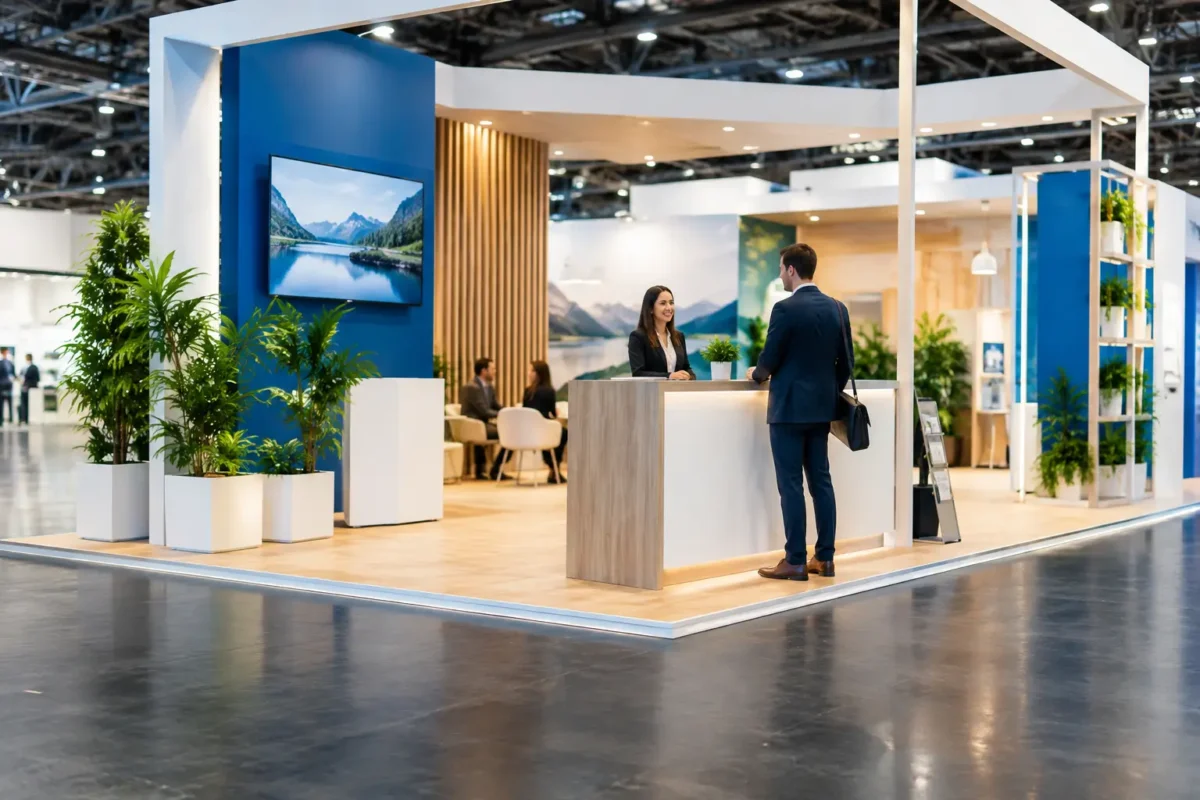
A busy exhibition hall gives visitors seconds to decide where to stop. The best exhibition stand ideas do more than create visual impact from the aisle: they make your offer understandable, give people a reason to enter and help your team start useful business conversations. For corporate brands, that balance matters. A stand should reflect the quality of the organisation behind it while working hard for the commercial objective.
The right concept depends on your audience, exhibition format, footprint, product complexity and how success will be measured. A regional technology exhibition may need private demonstration areas and meeting space. A life-sciences programme may need a calmer, more considered environment that supports detailed discussions. Before design begins, define the action you want visitors to take.
Start with a stand built around one clear objective
A strong exhibition stand is not a collection of attractive features. It is a physical expression of a campaign plan. Whether the priority is lead generation, product education, partner engagement or thought leadership, the objective should shape every design decision – from the headline visitors see at a distance to the follow-up process used by the on-site team.
For larger programmes, it is also worth mapping the visitor journey before approving a layout. Consider what catches attention, what explains the value proposition, where demonstrations happen, how staff qualify interest and where meaningful conversations can continue without interruption. This prevents a stand from looking impressive but feeling difficult to navigate.
Best exhibition stand ideas for meaningful engagement
1. Create a bold, single-minded brand message
Visitors should understand the broad purpose of your stand in a few seconds. Use one confident headline that speaks to a business challenge or outcome rather than trying to communicate every service line. Supporting messages can add detail once a visitor has stepped closer.
This approach is particularly effective for enterprise brands with complex propositions. A concise statement gives staff a natural starting point, while digital content, demonstrations and conversations can provide the necessary depth.
2. Use height strategically, not excessively
Overhead structures, illuminated signage and elevated branding improve visibility across a crowded floor. They can be valuable where a stand is surrounded by competitors or positioned away from a main entrance. However, height only works when it reinforces recognition and remains proportionate to the footprint.
A compact stand with an oversized feature can feel imposing or obscure the activity below. Exhibition regulations, rigging access and venue restrictions also need to be resolved early. A good design team will assess sightlines alongside practical build requirements.
3. Build a demonstration theatre
For products that benefit from explanation, a small presentation area can turn passive interest into a planned programme of engagement. Short sessions throughout the day give visitors a reason to return and allow your team to demonstrate expertise at scale.
Keep presentations focused and visible from the aisle. A screen alone is rarely enough: clear audio, a capable presenter, timed sessions and staff ready to continue conversations afterwards make the format work. If the event floor is noisy, headphones or a more enclosed setting may be the better choice.
4. Design live product demonstrations around real tasks
A product demonstration is most effective when visitors can immediately relate it to their own work. Instead of showing every feature, present a realistic scenario, a challenge and a clear result. This helps technical or specialist solutions feel more accessible without oversimplifying them.
Allow enough room for small groups to watch comfortably. If hands-on participation is part of the experience, separate the demonstration zone from the main circulation route so queues do not block entry to the stand.
5. Add a private meeting space with purpose
Semi-private meeting areas are often among the most commercially valuable elements of a corporate exhibition stand. They give account teams and senior stakeholders a professional place to hold pre-arranged meetings, progress complex discussions and build rapport away from the aisle.
Privacy should be matched to the nature of the conversation. A partly screened lounge can preserve energy and openness, while sensitive discussions may require an enclosed room. Do not allocate too much of a smaller footprint to meetings, though. The stand still needs enough visible activity to invite new visitors in.
6. Make hospitality feel considered
Hospitality can make visitors feel welcome, but it should support the brand rather than become the entire attraction. Quality refreshments, attentive service and comfortable seating encourage people to stay longer, particularly during full-day conferences or regional trade events.
The details matter. Locate service points so queues do not interrupt demonstrations, maintain a clean presentation throughout the day and ensure hosts can direct guests to the right team member. A well-run hospitality area communicates care and operational discipline.
7. Use interactive technology only when it earns its space
Touchscreens, product configurators, interactive maps and digital displays can create useful engagement when they help visitors understand something faster or tailor information to their needs. They should not be included simply because digital activity appears modern.
Every interactive feature needs a practical plan for content, connectivity, equipment testing and onsite support. It should also work for visitors who prefer a guided conversation. In many cases, a staffed screen experience is more productive than a self-service display that receives little attention.
8. Bring the brand story to life through materials and detail
The physical finish of a stand speaks before any conversation begins. Texture, lighting, furniture, graphics and floral or greenery choices can make a corporate brand feel warm, innovative, technical or established. Consistency is more persuasive than decoration for its own sake.
For organisations with sustainability commitments, consider reusable structural components, rental furniture, modular graphics and materials selected for responsible end-of-event handling. These choices need to be planned from the outset, as last-minute substitutions can affect both appearance and logistics.
9. Create an open invitation from the aisle
A stand can be visually striking yet unintentionally unwelcoming. High counters at the perimeter, furniture placed across entrances and clusters of staff talking to one another all create a barrier. Keep primary access points open and ensure the first interaction feels easy.
Position a knowledgeable greeter near the edge of the stand, not behind a desk. Their role is to acknowledge visitors, understand why they have stopped and introduce them to the appropriate colleague. This simple operational detail often has a greater effect on engagement than another visual feature.
10. Plan content for the moments between meetings
Not every visitor will have time for a full demonstration. Use brief, clear content for people passing by: a proof point, a client outcome, a short video or an easy-to-scan visual that answers a relevant question. These touchpoints keep the stand active while giving visitors a reason to return later.
Avoid overcrowding the walls with dense copy. At exhibition distance, clarity wins. Detailed technical collateral can be shared after a conversation, when it is more likely to be relevant and remembered.
11. Give visitors a useful reason to leave their details
Lead capture works best when the exchange is credible. Offer a consultation slot, technical briefing, research insight, event follow-up or tailored demonstration rather than relying on a generic giveaway. The value should connect directly with the audience you want to meet.
Agree the qualification questions and data-capture process with the sales team before the event. This ensures leads are consistently recorded and that post-event contact reflects the conversation a visitor actually had.
12. Treat staffing as part of the stand design
Even the strongest concept will underperform if the team is unclear about roles, key messages or how to manage peak periods. Staff numbers should reflect the planned activities, expected footfall and the need to host booked meetings while welcoming new visitors.
A concise briefing should cover visitor profiles, conversation openers, demonstration flow, lead qualification, escalation routes and presentation standards. For international programmes, it may also need to address local business etiquette, language requirements and travel arrangements. iCube Events approaches these details as part of the wider visitor experience, because consistent delivery is what allows a well-designed stand to perform as intended.
Bring the concept together with disciplined delivery
The most effective stands are planned early enough for creative ambition and operational reality to meet. Venue rules, electrical points, rigging, storage, freight schedules, build access, health and safety requirements and staffing rotas all influence what is possible. They should inform the design rather than be handled after it has been approved.
It also helps to test the concept against a practical question: will this stand still feel purposeful during the busiest hour of the day, and during the quieter periods? A flexible layout, well-prepared team and clear visitor journey will serve both moments.
The best exhibition stand idea is ultimately the one that makes the right people feel expected, understood and ready to talk. When creative design is supported by careful planning and attentive on-site coordination, the stand becomes more than a branded space – it becomes a credible setting for the relationships your business wants to build.