
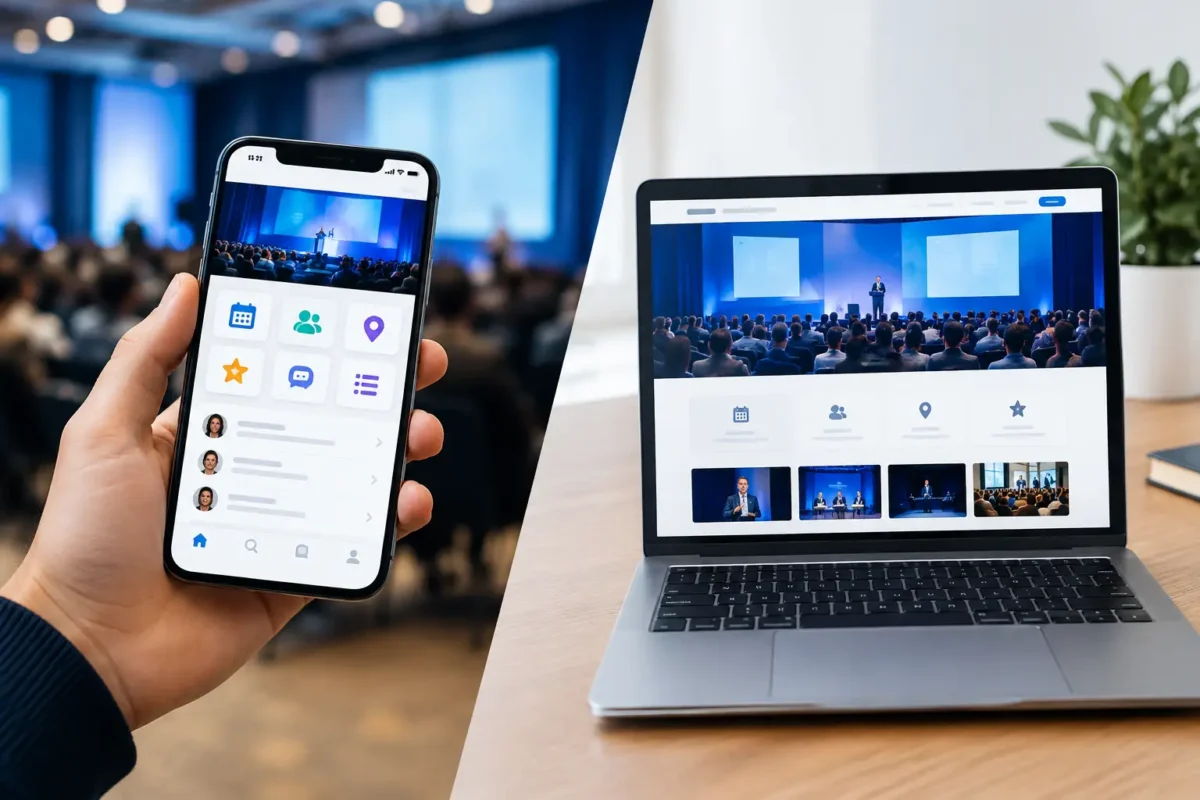
A conference app versus event website is not simply a technology decision. It shapes how delegates prepare, navigate the programme, engage with content and remember the experience afterwards. For corporate conferences, sales meetings and regional events, the right choice should support the business objective while remaining practical for every attendee.
An event website and a conference app can work well together, but they do different jobs. The most effective approach depends on the audience, programme complexity, event location, data requirements and the level of interaction required on the day.
Conference app versus event website: the core difference
An event website is usually the event’s public-facing or pre-event home. It gives prospective and registered attendees a place to understand the event proposition, review key information and complete actions such as registration. It can be accessed from a browser on any device, without requiring a download.
A conference app is typically designed for registered attendees and is most valuable once participation is confirmed. It places a personalised agenda, live updates, speaker information, venue maps, session materials and engagement features in one mobile-first space. Its strength is immediacy. Delegates can receive information while moving between sessions, meeting clients or travelling to the venue.
The question is therefore not which format is better in isolation. It is which format will remove friction at the point where your attendees need support.
When an event website should lead
For an event that relies on awareness, registrations or external stakeholder confidence, the website should take the lead. It gives an organisation a controlled, branded environment to explain the purpose of the conference, communicate the agenda at the right level and set expectations before a delegate commits to attending.
This is particularly relevant for exhibitions, customer forums, public-sector gatherings and conferences involving attendees from multiple markets. A browser-based site is simple to access, works well on desktop and mobile, and avoids the barrier of asking someone to install an app before they see the value of the event.
An event website is also the stronger choice where the programme is relatively straightforward. A focused leadership meeting, customer dinner or half-day workshop may need registration details, location guidance, speaker biographies and travel information, rather than an extensive digital companion. In these cases, an app can add another task without materially improving the attendee experience.
For regional programmes across Asia-Pacific, websites are useful for sharing travel guidance, accommodation details, visa reminders, venue directions and local contacts well before arrival. This information is easier to review on a laptop while a delegate is planning their journey, forwarding details to colleagues or seeking internal approval.
When a conference app earns its place
A conference app becomes more compelling when the programme is busy, personalised or likely to change. At a multi-track conference, delegates need to know not only what is happening, but where they need to be next and whether a session has moved, started late or reached capacity.
For a two- or three-day sales conference, an international meeting or an exhibition with hundreds of attendees, the app can act as the delegate’s day-of-event guide. It can bring together individual schedules, live notices, presenter profiles, session resources and practical venue information. This reduces reliance on printed programmes and gives organisers a clearer channel for time-sensitive communications.
The strongest use cases involve purposeful interaction. If the event owner needs session questions, polls, feedback, appointment scheduling or delegate networking, an app provides a more structured environment than email updates or paper forms. It can help event teams understand what content is attracting interest and where delegates may need additional support.
However, adoption should not be assumed. Senior executives, international guests and time-poor delegates may not download an app unless the benefit is obvious. The attendee journey must make installation easy, explain why the app matters and offer a sensible alternative for those who cannot or prefer not to use it.
The programme complexity test
Programme complexity is often the clearest decision point. If everyone follows the same agenda in one room, an event website and well-managed on-site communications may be sufficient. If delegates choose among concurrent sessions, move between venues or receive different meeting schedules, a conference app can provide meaningful value.
Consider a regional conference tour with local variations at each destination. The core agenda may remain consistent, but venue access, transport timings, dining arrangements and local contacts will differ. An app can help keep these operational details close at hand, provided the information is carefully managed and updated by a responsive event team.
Do not treat the choice as either-or
For many corporate events, the most considered solution is a website before the event and an app during it. The website attracts, informs and prepares. The app guides, engages and responds.
This division also helps protect the attendee experience from information overload. A website can present the conference story clearly to a broad audience, while the app can hold the detailed operational information that only registered delegates need. This might include room allocations, individual appointments, internal documents or last-minute changes.
The two channels must still feel connected. Branding, event naming, agenda terminology and key messages should be consistent. A delegate should not have to wonder whether the session title on the website is the same one appearing in their app. Behind the scenes, ownership of updates matters just as much as visual consistency. Out-of-date information creates confusion quickly, especially at events where schedules are closely timed.
Plan around the real attendee journey
Technology should be selected after mapping the attendee journey, not before. Begin with what a delegate needs at each stage: deciding whether to attend, registering, preparing to travel, arriving at the venue, navigating the programme, participating in sessions and following up afterwards.
For example, a life-sciences meeting may require clear pre-event information around attendance protocols, travel and approved materials. A technology conference may prioritise detailed session selection, product demonstrations and lead engagement. An executive audience may value concise briefing information and discreet hospitality coordination more than social features.
Accessibility and connectivity deserve equal attention. Some venues have inconsistent mobile coverage in certain spaces, while roaming arrangements can affect international visitors. Delegates should not be left unable to find a room or contact an organiser because a digital channel has failed. Printed contingency information, staffed help points and clear venue signage remain valuable parts of reliable event delivery.
Data governance is another practical consideration. Before introducing personalised schedules, networking functions or engagement tools, establish what attendee data will be collected, who can access it and how it will be managed. This is particularly relevant for corporate events involving client information, regulated sectors or internal business discussions.
Build the operational plan behind the platform
A polished app or website cannot compensate for weak content management. The most useful digital platform is only as accurate as the agenda, speaker details, venue information and attendee communications feeding into it.
Assign clear responsibility for updates. Agree who approves programme changes, who posts urgent messages and how changes will be communicated if a delegate has not opened the app. Test the attendee experience on common devices before launch, including registration flows, agenda views, notification settings and any interaction features.
It is also wise to prepare for the moments that are difficult to predict: a delayed speaker, a room change, weather disruption or a transport adjustment. In these moments, the value of a conference app is not its feature list. It is the event team’s ability to communicate calmly, accurately and quickly across every relevant channel.
At iCube Events, digital event touchpoints are planned as part of the wider attendee experience, alongside programme design, hospitality, venue operations and on-site coordination. That joined-up view helps ensure the technology serves the event rather than becoming another moving part to manage.
The best choice is the one your delegates will genuinely use and your team can maintain with confidence. Give attendees clear information before they arrive, dependable guidance when plans change and a thoughtful experience at every point that matters.