
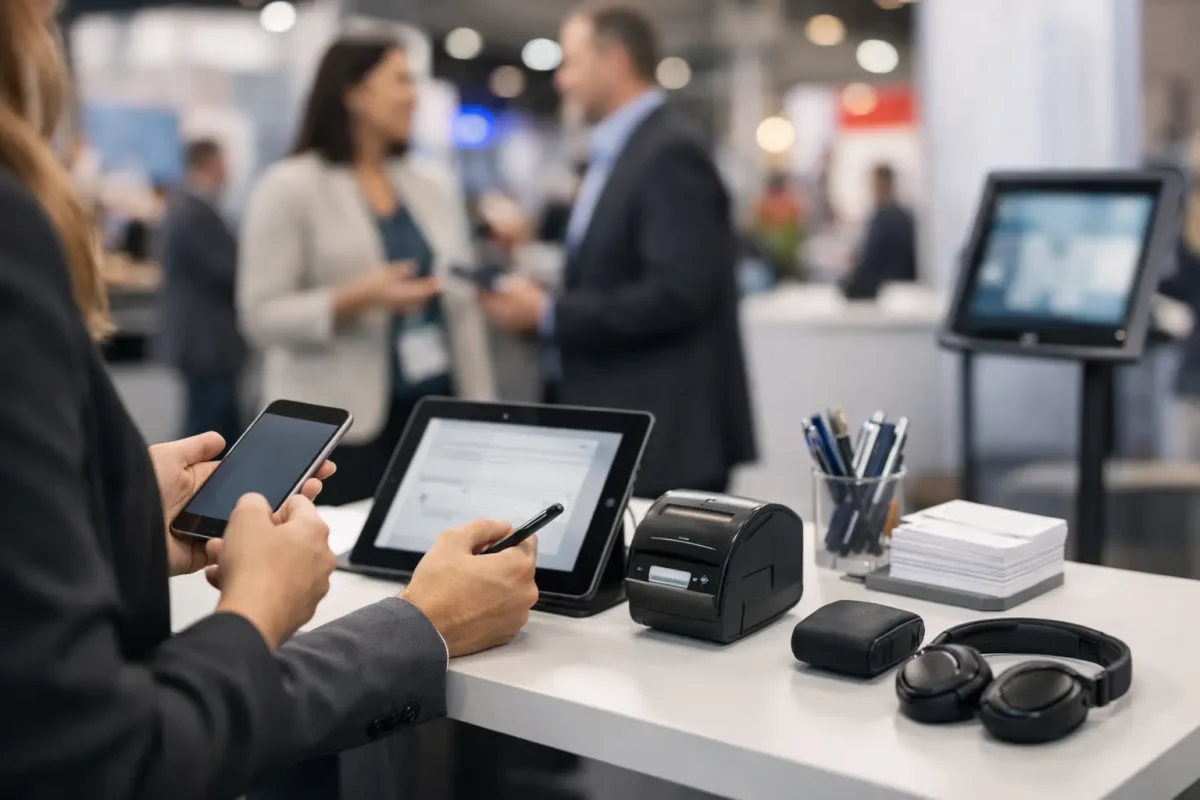
A busy exhibition stand can create the impression of success while leaving a sales team with little to act on. The essential trade show lead tools are not simply those that collect the most contact details. They help teams capture context, identify genuine opportunity and ensure that each worthwhile conversation receives the right follow-up.
For corporate exhibitors in Singapore and across Asia-Pacific, this matters especially at regional conferences and trade shows where travel, stand design, hospitality and senior stakeholder time represent a significant investment. A lead process should respect the quality of those interactions. It should also work reliably when the venue Wi-Fi is under pressure, the show floor is crowded and teams are speaking with attendees from several markets.
Start with the lead journey, not the technology
Before selecting a platform or device, define what should happen from the moment a visitor approaches the stand to the point at which a sales representative continues the conversation. A senior decision-maker requesting a product demonstration needs a different journey from a student gathering research, or an existing customer seeking support.
This distinction is often where lead programmes become diluted. When every scan is treated as equal, sales teams inherit an unprioritised list and marketing cannot accurately assess event performance. A practical lead framework establishes the information that matters: organisation, role, market, area of interest, buying timeframe, agreed next step and consent to further contact.
The best tools make this information easy to record without turning a human conversation into a form-filling exercise. For a complex enterprise offering, a short set of well-designed qualification prompts is more useful than a long questionnaire. For a high-volume exhibition, speed may take greater priority, with deeper qualification reserved for visitors who book a meeting or request a demonstration.
7 essential trade show lead tools
1. Badge scanning or QR capture
Badge scanning remains one of the fastest ways to capture accurate attendee details, particularly at organiser-led exhibitions where registration data is available through an approved system. QR capture can serve a similar purpose where attendees use digital tickets or event apps.
Its value is accuracy and pace, not qualification on its own. Confirm what information the organiser provides before committing to the service. Some systems share full attendee profiles, while others only provide basic details. Ensure the team knows how to add notes immediately after a scan, otherwise a valuable conversation can become an unexplained name in a database.
2. A mobile lead-capture application with offline capability
A lead app gives stand staff a structured way to record interests, notes and follow-up actions on a phone or tablet. Offline functionality is essential. Exhibition venue connectivity can fluctuate considerably, and a tool that only works with a strong signal can interrupt the very moments it is meant to support.
Look for a clear, low-friction interface that allows staff to select agreed fields quickly. Free-text notes still matter. They capture the nuance that checkboxes cannot: a client’s concern about regional deployment, a planned procurement review, or the name of a colleague who should join the next meeting.
3. A concise qualification form
The form within a lead app or scanning system is where commercial discipline takes shape. It should reflect the event’s business objective rather than generic marketing preferences. If the aim is pipeline creation, qualifying for role, business need, timeframe and next action may be appropriate. If the objective is market education, content interest and sector may be more meaningful measures.
Avoid asking staff to guess details they have not discussed. Inaccurate data creates false confidence and can undermine later reporting. A simple option such as “needs further qualification” is preferable to forcing an answer. Brief training and a few realistic role-play scenarios before doors open will improve consistency considerably.
4. Meeting booking and calendar tools
The strongest exhibition lead is often not a scan but a confirmed conversation after the show. A meeting-booking tool allows visitors to reserve a demonstration, consultation or follow-up discussion while interest is still current. It also helps teams protect the availability of subject-matter experts who may be supporting the stand for only part of the programme.
This approach is particularly effective for technology, life sciences and other considered purchases, where a brief trade show conversation is only the beginning of a longer evaluation. However, calendar access should be managed carefully. Establish clear appointment types, meeting owners and escalation routes so a booking is not made without the right expertise available.
5. CRM integration and lead-routing rules
A successful event can generate hundreds of records in a few days. Without a planned route into the customer relationship management system, manual exports and spreadsheets soon create delay, duplication and uncertainty over ownership.
Integration should map each capture field to the right destination, attach the event source and preserve the notes that give a lead meaning. Routing rules can then direct high-priority opportunities to the appropriate sales owner by account, territory, sector or product interest. For regional events, this is particularly valuable when a visitor is based in a different APAC market from the team hosting the stand.
Not every programme needs a complex real-time integration. For a focused executive dinner or smaller forum, a carefully managed post-event upload may be sufficient. The non-negotiable point is ownership: decide who validates data, who assigns leads and when the first action must take place.
6. Digital content-sharing tools
Visitors frequently ask for a brochure, case study, product specification or presentation after a conversation. Digital content-sharing tools make it easier to deliver relevant material without relying on large volumes of printed collateral. They can also show which resources generated interest after the event.
Content should be selected with care. Sending every available document can overwhelm the recipient and obscure the agreed next step. A tailored follow-up with one relevant asset and a clear meeting invitation is usually more useful. For regulated sectors, approval controls and version management are equally important so stand teams only share current materials.
7. Live dashboards for lead quality and stand performance
A simple live dashboard can help event owners make better decisions during the show rather than waiting for a post-event report. It may show total leads, qualified leads, meetings booked, popular topics, lead sources and activity by time of day.
Used well, this visibility helps a team adapt. If a product demonstration is attracting traffic but producing few qualified conversations, the stand messaging or qualification questions may need refinement. If particular sessions or hosted activities generate strong prospects, staff can allocate more attention there. Metrics should guide judgement, not become a target that encourages indiscriminate scanning.
Put people and governance around the tools
Technology cannot compensate for an unprepared stand team. Every person capturing leads should understand the event objective, the qualification criteria, the privacy statement and the promised response time. They should also know whom to involve when a high-value prospect arrives or a question requires specialist input.
Consent and data handling deserve early attention. Singapore’s Personal Data Protection Act and the requirements of other markets represented at an APAC event may affect how data is collected, stored and used. Be transparent about why information is being requested, record consent where required and align post-event communications with the permissions given. The most effective process protects both the visitor’s trust and the organisation’s reputation.
A short daily review during a multi-day event is often more valuable than a lengthy debrief at the end. Stand leaders can check lead quality, identify records needing clarification and make sure urgent opportunities have already reached the correct people. This also gives staff an opportunity to share observations that may not appear in a dashboard, such as recurring objections, changing visitor priorities or a competitor-free market trend worth investigating.
Measure what happens after the exhibition
Lead volume is an easy number to report, but it rarely tells the full story. A more meaningful view looks at the proportion of leads that were qualified, the speed of first follow-up, meetings completed, opportunities created and progress through the sales cycle. Marketing teams may also assess the content requested, audience profile and engagement generated by demonstrations or hosted experiences.
Allow for the reality of longer corporate buying cycles. An exhibition may initiate relationships that take months to mature, especially where multiple stakeholders, compliance requirements or regional budgets are involved. Capture the event source consistently so its eventual contribution can be understood without overstating short-term outcomes.
The right lead tools should make a visitor feel heard, not processed. When the capture process is matched to your commercial objectives, supported by prepared people and followed by prompt, relevant action, an exhibition conversation can become the start of a trusted business relationship.