
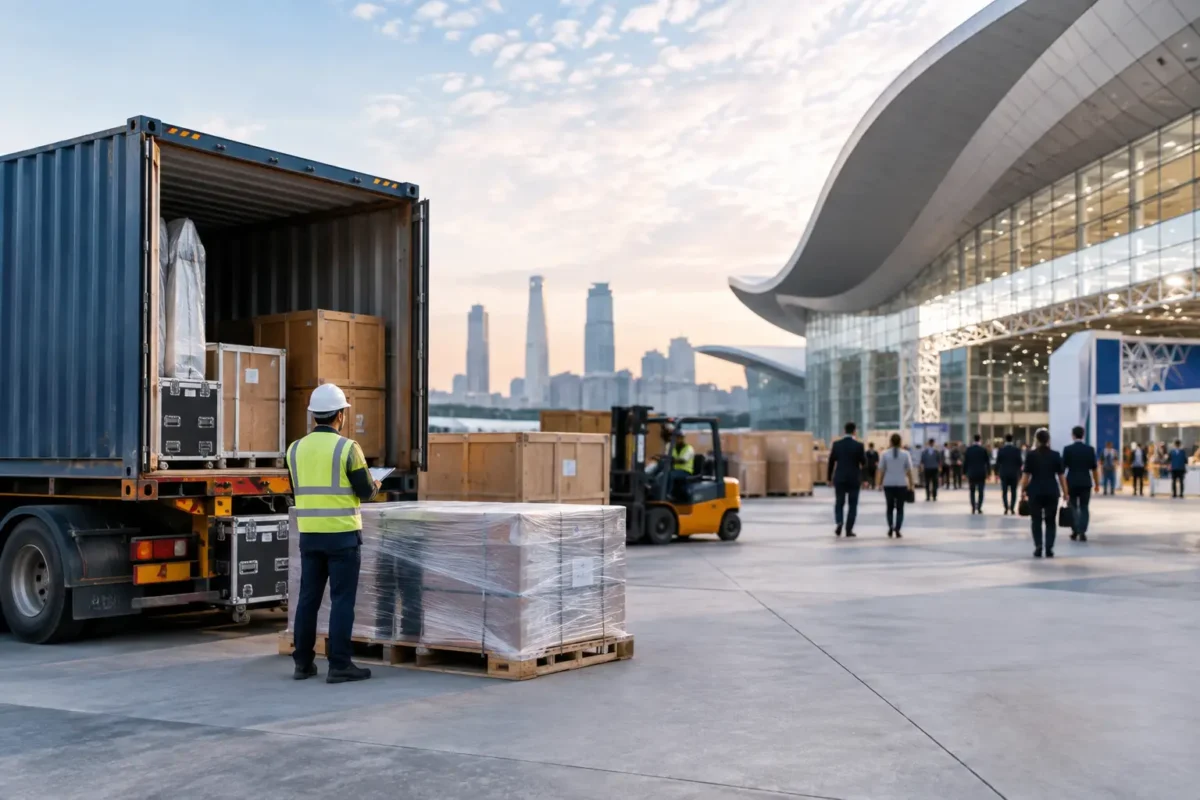
A stand can be beautifully designed, the product team can be fully briefed, and the exhibition calendar can be locked in months ahead. Yet if a demonstration unit is held at customs or graphics arrive after the build window, the whole investment is put at risk. This exhibition freight forwarding guide is designed to help corporate event teams protect the details that attendees may never see, but will certainly feel when they go wrong.
For regional and international exhibitions, freight is not simply a transport booking. It is a timed, documented and venue-specific operation involving collection, export, import, customs clearance, delivery, storage and return. The right approach begins well before the exhibition organiser’s deadline and treats logistics as part of the attendee and exhibitor experience.
Start with the exhibition’s operational reality
Every venue, organiser and destination has its own freight rules. Before confirming transport, obtain the exhibitor manual and review it alongside the stand plan, production schedule and show calendar. Look beyond the published move-in date. Identify the exact build access slot, loading-bay process, permitted vehicle size, material-handling requirements, storage rules and cut-off for advance warehouse delivery.
A shipment arriving at the venue is not automatically available at the stand. It may need to be received by an official contractor, moved by approved handlers, stored until a scheduled delivery slot, or collected from an advance warehouse. These services can affect timing and the overall event budget, particularly at large regional trade shows where vehicles and loading bays are tightly managed.
The nature of the cargo matters just as much. A lightweight pop-up stand, a pallet of brochures and a high-value live product demonstration require different handling plans. Fragile equipment may need purpose-built flight cases. Temperature-sensitive samples may need a controlled solution. Battery-powered devices, liquids, magnetic materials and equipment containing data can introduce additional restrictions or declarations.
Work backwards from the stand handover
The most useful deadline is not the day the exhibition opens. It is the moment your stand contractor needs every item in place to complete installation, test technology and prepare for client meetings. Work backwards from that handover point, allowing for venue handling, customs clearance, local delivery and a realistic contingency period.
For a conference exhibition in Singapore, a domestic or regional shipment may offer more flexibility than a cross-border consignment. For an event in Japan, Korea, Thailand, Vietnam or another APAC destination, the customs process, local public holidays and final-mile arrangements may require materially more lead time. There is no single number of days that works for every show. The right schedule depends on the commodity, origin, destination and the event’s operating rules.
Avoid relying on the final delivery deadline as a target. It is a last acceptable point, not a preferred plan. Earlier arrival at an approved warehouse can create useful protection, provided storage conditions and release arrangements are confirmed in writing.
Exhibition freight forwarding guide: documents first
Customs delays often begin with incomplete or inconsistent paperwork. A freight forwarder can advise on required forms, but the exhibitor remains responsible for supplying accurate information about what is being shipped, its value, ownership and intended use.
Prepare a detailed packing list that matches the physical shipment case by case. Generic descriptions such as “event materials” are rarely sufficient. List each item clearly, including quantities, serial numbers for equipment where relevant, country of origin and reasonable declared values. If a shipment includes both promotional collateral and reusable display assets, distinguish between them.
The documentation commonly needs to address the following:
- a commercial or pro forma invoice describing the goods and their value;
- a packing list showing the contents, weights and dimensions of each case or pallet;
- transport documents and any required customs declarations;
- temporary import paperwork where goods will leave the destination after the event; and
- permits or supporting certificates for restricted, regulated or specialised goods.
Temporary import arrangements are particularly significant for reusable stands, audiovisual equipment, product demonstrators and display stock. The objective is to bring goods into a country for the exhibition and export them again without creating unnecessary duty exposure. The appropriate method varies by destination and cargo type. It must be agreed before dispatch, not improvised when the freight reaches the border.
Consistency is essential. The item descriptions, quantities and values on the invoice should align with the packing list and any temporary import record. A missing serial number or a different description can slow release at precisely the point when the on-site team is managing a build schedule.
Choose transport around risk, not preference
Air freight is often chosen for exhibition cargo because it is fast, but speed alone does not make it the right answer. It can be appropriate for time-critical graphics, replacement parts, smaller display systems and high-value equipment. Sea freight can suit large, heavy or less urgent consignments where the timetable includes sufficient buffer. Road transport may be practical for cross-border events within parts of Southeast Asia, subject to route, border and vehicle considerations.
A mixed plan can be more resilient than placing every item on one service. For example, core stand structures and non-urgent collateral may move earlier, while current product samples or final campaign materials travel later under closer control. This approach creates more coordination work, so it needs a single, well-maintained inventory and clear ownership across teams.
Do not send irreplaceable items unless their role is genuinely essential. Digital files, locally produced collateral, rental furniture or locally sourced consumables can reduce exposure. This is not a compromise in quality. It is a practical decision about what must travel and what can be delivered reliably near the venue.
Pack for repeated handling
Exhibition freight is handled more often than ordinary deliveries: at collection, consolidation, airport or port, customs inspection, warehouse receipt, venue transfer, stand delivery and return collection. Packaging should be designed for that journey.
Use durable, clearly labelled cases and include an external reference that matches the packing list. Mark each piece with the exhibitor name, event name, stand number, venue, destination contact and case sequence, such as “1 of 8”. Avoid placing the only copy of vital instructions inside a case. Keep digital and printed copies available to the event lead, freight partner and stand contractor.
Insurance should be reviewed against the actual replacement cost and the scope of cover. Event teams should understand what is excluded, how claims are evidenced and whether cover applies while goods are stored at an advance warehouse or on the exhibition floor. For specialised equipment, photographs and condition records before dispatch are sensible safeguards.
Plan the venue handover as carefully as the journey
The final mile is where freight forwarding becomes event operations. Nominate one person with authority to confirm delivery status, accept cases and reconcile the inventory on site. That person should know which items are critical for build, which can remain in storage and what to do if a case is missing or damaged.
Arrange a practical communication rhythm between the forwarder, event manager, stand builder and client team. A short status update before collection, departure, customs clearance, warehouse receipt and venue delivery can prevent assumptions from becoming last-minute problems. For larger exhibitions, a shared tracker with shipment references, owner, location, planned arrival and exceptions is often more useful than a long email chain.
Venue staff may not permit exhibitors to use their own trolleys, unload at an unscheduled time or retain empty cases behind the stand. Confirm these restrictions early. If packaging must be removed, decide how the stand will be protected during the show and how goods will be repacked for return. Empty-case storage, return labels and collection appointments are easy to overlook during build-up, but they determine how calmly the team can close down after the final visitor leaves.
Treat return freight as part of the original plan
Return logistics should be designed at the same time as the outbound movement. Identify what will be reused, consumed, distributed, donated locally where permitted, destroyed under an approved process, or returned. This reduces avoidable volume and helps the team prepare accurate return documentation.
At close, use the original inventory to check every case. Record new damage, confirm serial-numbered equipment and ensure the return packing list reflects what is actually leaving the venue. If goods entered under a temporary import arrangement, proof of re-export may be needed to close the process correctly.
For corporate teams managing an exhibition alongside executive meetings, customer hospitality or a regional conference programme, this discipline is especially valuable. It allows the client-facing team to focus on conversations and commitments while the operational plan keeps moving in the background. iCube Events applies this same joined-up thinking across exhibition and event delivery, bringing the right people together around the details that protect the wider programme.
The most dependable freight plan is rarely the fastest-looking one. It is the one that gives every stakeholder a clear role, allows time for the unexpected and gets the right materials to the right stand before they become urgent.