
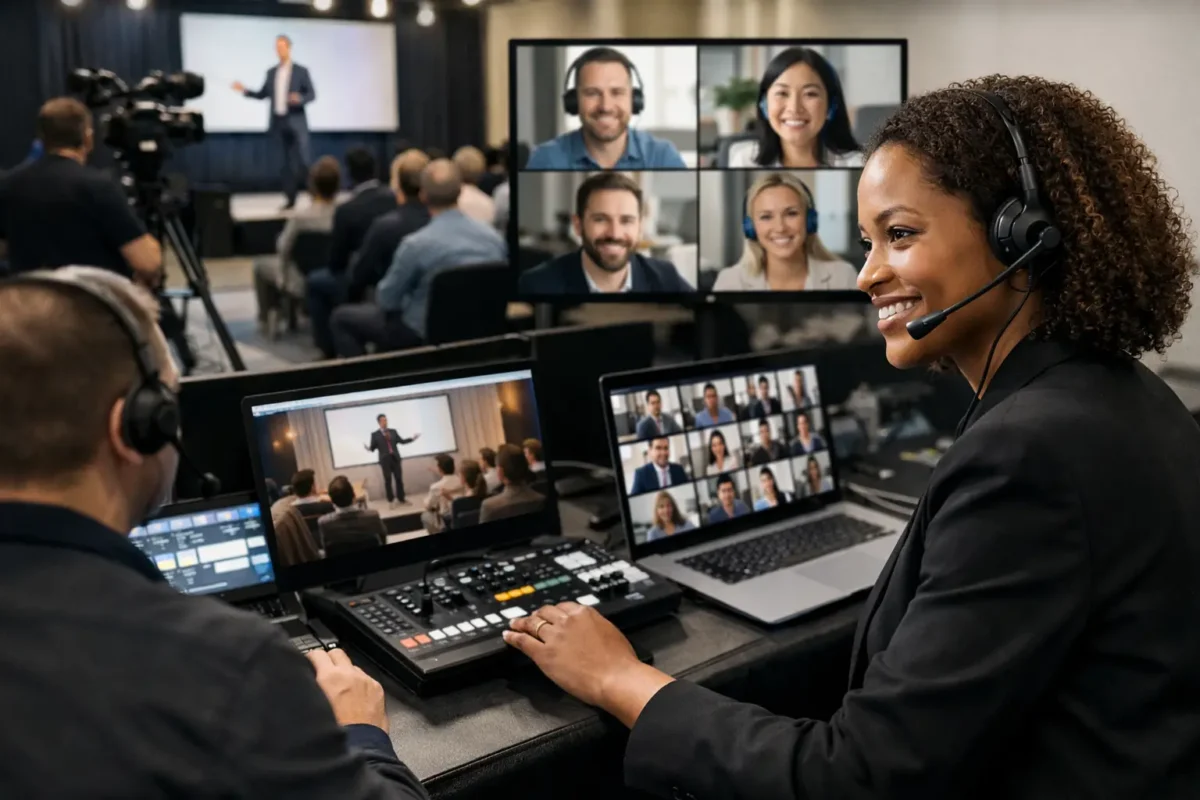
A keynote can be perfectly delivered in the ballroom and still fall short for remote delegates if a question goes unanswered, a presentation feed is delayed or an online participant cannot find the right session. Hybrid event staffing closes that gap. It gives the in-person and virtual experience equal operational attention, while recognising that each audience needs support in different ways.
For corporate conferences, regional sales meetings and exhibitions, the staffing model is not simply a matter of adding a virtual moderator to a conventional event crew. It is a considered plan for people, responsibilities, communication and decision-making. Done well, it protects the event’s business purpose and helps every delegate feel included, wherever they join from.
Why hybrid events need a different staffing model
At a physical event, event staff can often resolve an issue through proximity. A delegate looking for a meeting room can be directed in seconds. A speaker can be briefed backstage. A queue at registration is immediately visible.
Virtual participants have no such visual cues. They may encounter difficulties with access, audio, chat functions or networking without anyone noticing unless a designated team member is monitoring their journey. Meanwhile, the on-site programme continues at its own pace. The central challenge is to manage two live environments that must feel connected, not merely run at the same time.
This is especially relevant for organisations hosting attendees across Singapore and Asia-Pacific. Time zones, differing connectivity conditions, language requirements and varied levels of familiarity with event technology can all affect participation. A staffing plan should account for these realities before invitations are issued, rather than treating them as issues to solve on the day.
The right structure depends on the programme’s scale and complexity. A focused leadership broadcast may need a lean team with clear handovers. A multi-track conference involving sponsors, exhibitors, live polling and remote speakers requires more specialised coverage. In both cases, roles need to be defined early enough for teams to rehearse together.
The core roles in hybrid event staffing
A strong hybrid event team works as one operation, but it should not rely on one person to manage every attendee need. The following responsibilities typically need clear ownership:
- An event lead who oversees the programme, client decisions, on-site coordination and escalation of significant issues.
- A virtual event lead who monitors the digital attendee journey, platform activity and communications with remote speakers and delegates.
- Session managers who keep speakers, presentations, timings and transitions on track in each room or stream.
- Audience support staff who handle registration, access queries, chat moderation, polling, networking requests and practical delegate assistance.
For larger programmes, these roles may be supported by technical producers, speaker managers, hospitality personnel, exhibition coordinators and runners. The number of people matters, but role clarity matters more. If a remote attendee reports that a presentation is not visible, the team should know exactly who responds, who checks the technical feed and who keeps the speaker informed.
A tailored team also prevents senior client stakeholders from being drawn into operational decisions during the programme. They should be free to host customers, engage employees or focus on the content, with confidence that the event team is managing the details.
Give virtual delegates an advocate
Remote audiences are often treated as viewers rather than participants. That approach limits the value of a hybrid format, particularly when the event is intended to build alignment, educate customers or generate meaningful conversations.
A virtual event lead should act as the advocate for this audience. This person watches engagement levels, flags unanswered questions, prompts presenters when remote input should be brought into the room and helps ensure that online delegates are not forgotten during informal moments. They should also have the authority to recommend practical adjustments, such as repeating a question asked from the floor or extending a digital networking window when participation is strong.
This role is not about forcing every activity into a digital equivalent. Some on-site experiences will remain distinct. The aim is fairness of access to the event’s most valuable content, conversations and outcomes.
Build staffing decisions around attendee journeys
The most reliable plans begin by mapping what each attendee experiences from registration to follow-up. Consider the difference between a delegate arriving at a venue and one joining from an office in another market. One needs signage, welcome support and wayfinding. The other needs joining instructions, a tested access link and confidence that help is available without interrupting the session.
The same distinction continues throughout the programme. During a panel discussion, the in-room audience may raise hands while virtual attendees use a Q&A tool. During a product demonstration, those at the venue may inspect a display while remote participants need a close camera angle, clear commentary and an opportunity to submit questions. At the close of the session, both groups may want access to materials or a route to book a follow-up conversation.
Mapping these points makes staffing requirements more precise. Rather than assigning people generally to “support the event”, organisers can decide where support will have the greatest impact. It also exposes gaps that are easy to miss, such as who contacts a remote speaker if they have not joined ten minutes before their session, or who moderates questions while the host is introducing the next item.
Rehearsal is where the team becomes one team
Technical checks are essential, but a hybrid rehearsal should go further. It should test the human processes around the technology: speaker arrivals, introductions, presentation changes, audience questions, escalation routes and contingency communications.
A useful rehearsal includes representatives from the client team, event management, venue operations and technical production. Each party needs to understand what information they will receive, when they will receive it and who has the final call if the programme needs to change. A short delay can create confusion when updates reach the physical room but not the virtual audience, or the other way round.
Run through the moments most likely to place pressure on staff. Test a late speaker arrival, a lost connection, a change to a session room, a large volume of online questions or an over-running presentation. The purpose is not to expect failure. It is to ensure that the team can respond calmly and consistently if conditions change.
For cross-border programmes, rehearsals are also the right place to confirm time-zone references, naming conventions and local contact details. These small details influence how assured an event feels to delegates and stakeholders.
Communication rhythms make delivery more dependable
Hybrid teams need more than a group chat. They need a communication rhythm that distinguishes routine updates from urgent action. Before doors open, every team member should know the run sheet, their reporting line, the key client contacts and the process for escalating an issue.
During the event, short scheduled check-ins can keep the physical and virtual teams aligned without creating unnecessary noise. For example, a session manager may confirm speaker readiness with the virtual lead before each programme block, while the event lead receives only the updates that require a decision or affect the wider attendee experience.
This discipline is valuable when programmes involve several rooms, regional presenters or a mix of live and pre-recorded content. It avoids duplicated effort and makes handovers clearer. Most importantly, it creates a composed experience for attendees. They should see a well-managed programme, not the coordination required behind it.
Plan for the trade-offs, not just the ideal scenario
Hybrid delivery involves choices. A highly interactive format may demand more moderators and longer preparation than a broadcast-led session. Offering simultaneous networking to both audiences can be worthwhile, but only if the format and staffing level allow conversations to be facilitated properly. Recording every session can extend content reach, yet it also requires permissions, production planning and a clear approach to post-event access.
It depends on what the event must achieve. If executive messaging and content consistency are the priority, a focused virtual layer with responsive support may be the best fit. If relationship-building and lead generation are central, investment may be better directed towards skilled facilitators, networking hosts and dedicated attendee follow-up.
Budget and timeline constraints should shape the plan honestly. The answer is not always more people. Sometimes it is a simpler programme, fewer concurrent sessions or a more deliberate split between live interaction and on-demand content. An experienced event partner can help identify where staffing protects the attendee experience and where a different format may be the more practical choice.
Make the staffing plan part of the event strategy
Hybrid event staffing is most effective when it is discussed alongside objectives, audience design and programme development, not after the agenda is finalised. Early planning allows the team to match resources to the moments that matter most, from executive presentations and technical demonstrations to customer conversations and regional engagement.
At iCube Events, this means building a client service team around the needs of the programme and maintaining close communication from planning through on-site delivery. The detail may vary between an intimate workshop and a conference for hundreds of participants, but the principle remains the same: every attendee should know where to turn, and every team member should know what they own.
When attendees leave with clear information, useful connections and confidence in the organisation behind the event, the staffing plan has done more than keep the programme moving. It has supported the relationship the event was designed to build.