
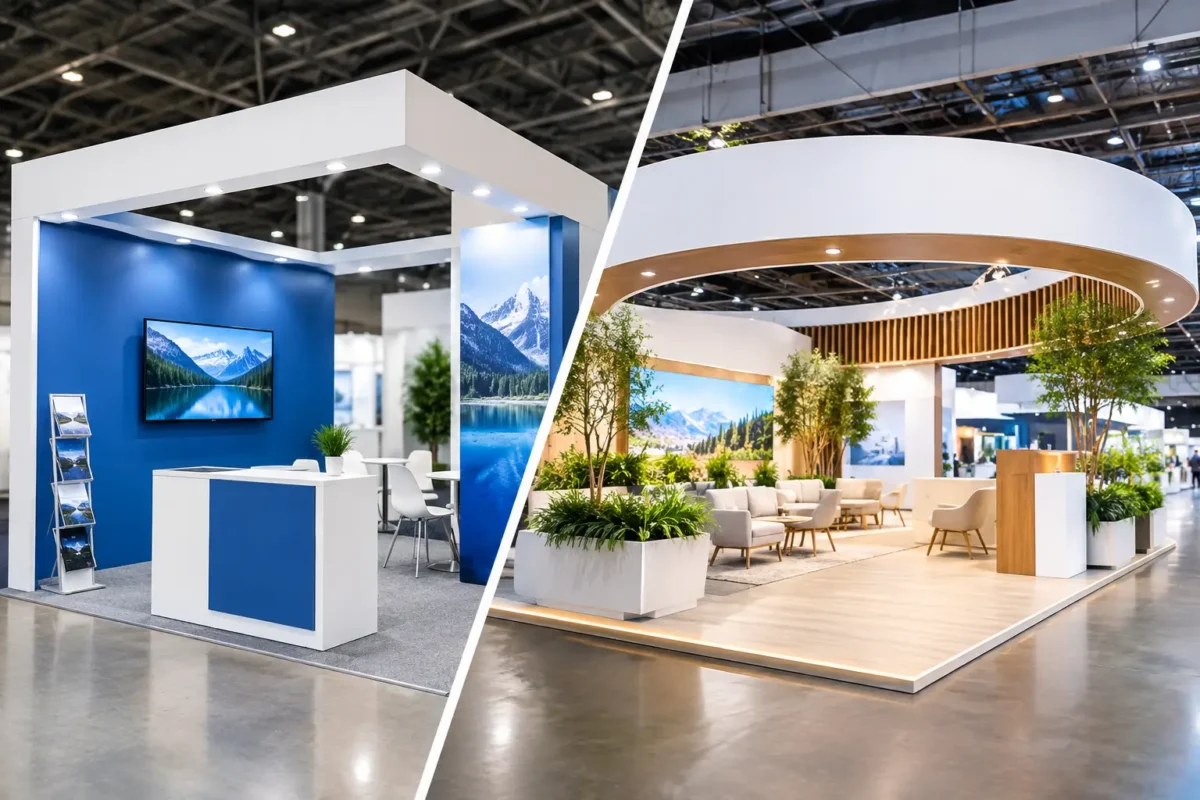
The exhibition floor plan often presents a deceptively simple choice: book a trade show booth or commit to a pavilion. Yet the decision affects far more than the footprint of your stand. A trade show booth versus pavilion decision shapes how visitors encounter your brand, how your team works the floor, how much coordination is required and whether the investment supports a clear commercial objective.
For regional marketing teams, the right format is rarely the largest or most elaborate option. It is the one that gives the right audience a credible, well-managed reason to stop, engage and continue the conversation after the event.
What separates a booth from a pavilion?
A trade show booth is an individual exhibitor space, usually positioned within an organiser-led exhibition hall. It may range from a compact shell-scheme unit to a custom-built island stand. The brand has direct control over its visual identity, product displays, staffing approach and visitor experience within that allocated area.
A pavilion is a larger, collective presence that brings multiple exhibitors together under a shared country, industry, association or corporate banner. It can include individual pods or counters, shared meeting areas, common hospitality zones and overarching pavilion branding. In some cases, a company may take a pavilion-style space for several business units, partners or regional markets rather than exhibiting as a single team.
The distinction matters because the visitor experience changes. A booth asks attendees to seek out one brand. A pavilion creates a destination around a broader theme, then helps participating organisations benefit from collective visibility and traffic.
Trade show booth versus pavilion: the practical differences
Neither format is automatically better. The stronger choice depends on the role the exhibition plays in your wider sales, marketing and stakeholder programme.
When an individual booth is the better fit
An individual booth gives a company clear ownership of the conversation. It is often the best choice when launching a product, demonstrating a complex solution or building relationships with a defined prospect list. The team can shape every detail, from the first visual message at the aisle to a private discussion area for qualified leads.
This control is especially valuable for enterprise technology, life sciences and specialised B2B organisations. If visitors need time to understand a technical proposition, view a demonstration or meet subject-matter experts, the booth can be designed around those moments. A modest but purposeful space with strong messaging and an organised meeting schedule can outperform a larger stand that lacks a clear engagement plan.
A booth also allows brand teams to maintain consistency across markets. For organisations exhibiting in Singapore and across Asia-Pacific, a modular design system, adaptable collateral and repeatable visitor journey can help regional teams present one coherent identity while accommodating local venue conditions and audience expectations.
The trade-off is responsibility. The exhibitor must generate its own pull through pre-event outreach, on-floor activity and follow-up. It must also manage every practical element, including stand design, contractor coordination, freight, staffing, lead capture, cleaning, electrical requirements and compliance with organiser deadlines.
When a pavilion brings greater value
A pavilion can be effective when strength comes from association, scale or a shared narrative. A national delegation at an overseas trade show, a group of solution partners or several divisions within a large organisation may attract more attention together than they would separately.
For visitors, a well-planned pavilion makes discovery easier. They can enter one identifiable area, compare complementary offerings and move from an initial conversation to a broader ecosystem discussion. Shared lounges and hospitality spaces can also create a more welcoming setting for senior stakeholders, media or hosted buyer meetings.
The pavilion model can reduce duplicated infrastructure. Rather than each participant arranging separate reception counters, meeting rooms, storage and hospitality provisions, the group can use common facilities. This can be particularly helpful where venue space is constrained or where teams are travelling internationally with limited on-site resources.
However, a pavilion requires disciplined governance. The overall identity must be clear without making individual participants invisible. Visitor flow needs to prevent crowding at popular counters while ensuring quieter exhibitors are not overlooked. Decisions on shared costs, staffing, brand approvals, lead ownership and meeting-room access should be agreed before design work begins, not improvised during build-up.
Start with the outcome, not the floor space
The most useful question is not, “How big should we be?” It is, “What needs to happen here for this exhibition to be worthwhile?” The answer may be lead generation, account meetings, partner recruitment, market education, investor engagement or brand presence in a strategically important sector.
If success depends on high-quality conversations with a small number of decision-makers, an individual booth with a calm, semi-private meeting environment may be appropriate. If success relies on demonstrating market capability, convening an ecosystem or helping multiple stakeholders participate under one credible platform, a pavilion may create more momentum.
Audience behaviour should guide the choice too. At a busy, broad-based exhibition, a pavilion can function as a highly visible landmark and give visitors a reason to explore. At a specialist event where buyers arrive with a prepared shortlist, an individual booth with precise pre-event appointment setting may be more effective.
It also depends on how established your brand is in that market. A recognised organisation with a strong point of view may benefit from a distinctive standalone presence. A business entering a new territory may gain confidence and context through a respected collective platform, provided it still has a clear story to tell within it.
Consider the operational reality early
Exhibition formats are judged by what visitors see, but their success is decided months earlier through planning. A booth can appear simpler because fewer parties are involved. A pavilion can appear efficient because resources are shared. Both assumptions can fail without a detailed operating plan.
For a standalone booth, map the visitor journey from aisle attraction to follow-up. Clarify who greets, who qualifies, who demonstrates, who hosts meetings and who records next actions. The physical design should support the team rather than force them to work around it. A congested demonstration zone, insufficient storage or an exposed meeting table can undermine an otherwise impressive build.
For a pavilion, establish a single decision-making structure and a realistic approval timetable. Participating organisations need clear specifications for artwork, deadlines for exhibitor information, access arrangements, staff passes, hosted meetings and lead-handling protocols. A shared pavilion manager can maintain standards across the space and resolve issues before they affect the attendee experience.
Logistics deserve equal attention. International exhibitions may involve customs documentation, freight schedules, venue delivery windows, local contractor rules and restrictions on rigging, food service or audio-visual equipment. Teams travelling from different Asia-Pacific markets also need practical guidance on accommodation, transfers, rehearsal timings and escalation contacts. These details are rarely visible to visitors, but they protect the calm, professional experience your brand intends to deliver.
Design for conversations, not just attention
A visually striking stand can draw a crowd, but a commercial exhibition presence should help people take a useful next step. That may mean a product demonstration, a consultation with a regional expert, a scheduled meeting or a concise introduction to a wider portfolio.
For booths, the design can reflect one focused journey: attract, explain, demonstrate and meet. For pavilions, it should balance the collective story with easy navigation to each participant. Clear sightlines, legible signage and thoughtful zoning matter more than decorative complexity. Visitors should understand where they are, what is available and whom they should speak with within seconds.
Hospitality should be purposeful as well. Refreshments, charging points or a comfortable lounge can improve dwell time, but only when the space remains accessible and staffed. A hospitality area that becomes a private retreat for the team can unintentionally close off valuable conversations.
Make the format work beyond the event
The exhibition itself is only one part of the programme. Before doors open, invite priority accounts, brief internal teams and prepare messages that match the event objective. During the show, hold short daily reviews to assess footfall, meeting attendance, common visitor questions and stock levels. Afterwards, follow-up should be prompt, owned and relevant to the conversation that took place.
This is where an experienced event partner can add practical value. iCube Events helps teams align design, logistics, hospitality and on-site coordination around the business outcome, while keeping stakeholders informed through each decision. The aim is not simply a polished space, but an exhibition operation that supports the people representing the brand.
Choose the booth when your message needs dedicated ownership and focused engagement. Choose the pavilion when a shared platform strengthens the story and the operating model is ready to support it. In either case, the most memorable presence is one where every visitor interaction feels considered, every team member knows their role and the next conversation is already planned.